Monday, February 28, 2011

Singapore's Dynamic Food Scene.

Everyone told us we would really enjoy the food in Singapore.  I have to admit: I was skeptical.  I am not a huge fan of Asian cuisine.  I don't mind it, but it's just not something I crave.  But after visiting Singapore I realize why I have never particularly craved Asian food--I just have never had good, authentic versions of it.  Because of the diverse cultures that make-up Singapore's population, you can eat Malay, Thai, Korean, Chinese, Indian, and a hybrid food that is Malay-Chinese called Peranakan.

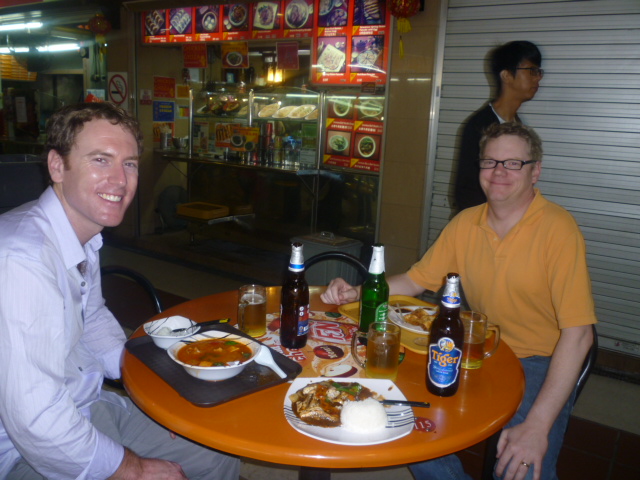
Food vendors are highly regulated in Singapore.  Food stall owners are forced to post their grades from the health department--A, B, or C so customers know the sanitary conditions.  You can either find these vendors clustered open tent structures or more bricks and mortar, still open air structures called Hawker Centers.  There are several famous ones, such as Maxwell Road in Chinatown or Newton Circus, but there are small ones peppered throughout the city.  One night, we stumbled on a small, Hawker Center with about ten food stalls and a clutch of tables being staffed by a lively barmaid.  You order your food and then go to a different stall and order a beer and then staff from the stalls bring your food to you and you pay them.  The range of foods at these stalls is impressive--stir-fry noodle and rice dishes, dumplings, kebabs, soups, and each vendor tends to specialize in chicken or beef or seafood.  Because of the diverse population that includes Muslim and  Hindu, halal and vegetarian options are in abundance.  Not only are the choices impressive, food is dirt cheap.  We averaged spending $10 per person and that includes one or two beers.  Although hotels are pricey in Singapore, food and public transit make Singapore a destination for travelers of all price points.

Kevin and Chris eating at the Maxwell Road Hawker Center in Chinatown.

Besides the Hawker Centers, a slightly more tame version of the vendor scene can be found in the plethora of malls that are literally on every corner and part of every MRT station in downtown Singapore.  To escape a rainstorm on our first day, we scurried into a mall near the Botanical Gardens and enjoyed an amazing meal of spicy squid.  We continued to eat our way through the food courts and hawker centers during our visit, usually eating at least one, if not two meals there each day. 

I can say that I never tired of the fresh, stir-fried meals and now crave Asian food--at least the kind you can eat in Singapore.


Wednesday, February 16, 2011

Sentosa Island—very faux, but very fun.

Heading to Sentosa Island via the cable cars.

Full disclosure: I haven’t been to Disney World since I was ten and other than passing through the airport, I haven’t been to Las Vegas so I lack the expertise of faux kingdoms and do not necessarily seek them out.  Still, we had heard a lot about Singapore’s Sentosa Island so for my one, conference-free day, we decided to check it out. 
It’s easy to reach Sentosa and there are a lot of ways to get there: by car via a bridge, by monorail, by ferry, and if you want to pull out all the stops—by cable car.  We chose to splurge and live it up—we took the cable car!  I had not been on a cable car in years—and realized, I’m not a huge fan of being suspended from a tiny cable, but the views of Singapore and Sentosa were worth the queasy knot in my stomach. 
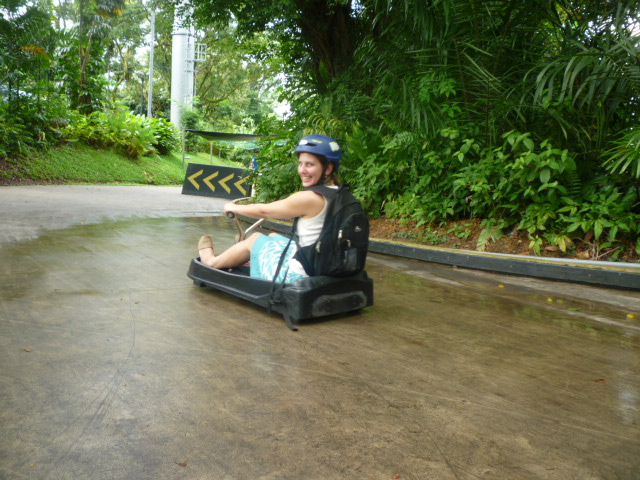
Anne taking the luge ride down to Silosa Beach.
As you approach Sentosa, you notice there is a flurry of construction still going on.  You also notice a giant stone lion head emerging from a jungle tangle.  Sentosa is home to a Universal Studios, a Casino that costs $80 just to enter, and an array of other amusements and attractions.  It’s like Singapore’s very own theme park and I could see how it’s a great little family retreat for locals.

As we climbed out of the cable car, they offered to sell us a picture of us in the cable car.  As you step out of the cars, you are assaulted by a shop filled with souvenirs and little tables filled with knickknacks and one table with a guy offering you the amazing chance to hold a snack and have a picture taken—uh, no thanks! 
And every aspect of Sentosa is an amusement--luge rides, chair lifts, water shows, aquariums, rock walls, sand volleyball courts, trapeze and tight-rope walking opportunities.   We scurried over to the luge, which affords you the opportunity to ride down to the main beach—Silosa—in a seriously fun way and then take a chair lift back up to the top.  I have to say, the luge ride was a blast and I had a dopey grin on my face the whole time.  Of course, photos were snapped and offered to us for sale.  As we took a few candid shots on the way down, we declined the opportunity.
Kevin examining a fake rock on the man-made beach.
We spent the rest of the daytrip, wandering the manmade beaches and little islands (connected by piers and rope bridges) of Sentosa.  We lucked out and had a rain-free day (the only one of the trip!).  It was a Thursday so it was pretty quiet.  The beach walks were pleasant and the faux rock boulders and little islands dotting the way were charming.  I have to say, I enjoyed our beach stroll.  We stopped for some overpriced beer and bad pizza at a beach bar, but sitting on a terrace watching the quiet afternoon go by made up for the food.  As Kevin observed, we counted Sikhs, Indian, Chinese, American and many other tourists/locals enjoying Sentosa—all happy, all seeking a quiet afternoon.  Moments like that make the world feel smaller and that our differences are not so vast.  Who knew we’d find such a philosophical lesson on corny Sentosa Island?

Saturday, February 12, 2011

Singapore’s MRT: The Greatest Subway in the World.

I am not prone to hyperbole so the title of this blog entry is stating the truth: I was blown away by Singapore’s public transportation infrastructure.  Efficient, cheap, vast, it was everything you could want in a transportation system.  I think a lot of cities and countries could learn a few lessons by studying the MRT (are you listening Metro?). 
The plastic card you recycle for a deposit after a trip is complete.
First, let me list my qualifications as to why my opinion is valid.  I have been a commuter on DC’s Metro for the last 10 years.  Besides my daily commute, I have used the New York subway, the Boston MBTA, the Chicago CTA, the London Underground many times.  I have also tried San Francisco’s BART, Prague’s Metro, Metro de Madrid, Athens’ Metro, Paris’s Metro, Vienna’s U-Bahn, the tram systems of Amsterdam and Oslo, and many bus lines across the United States, Mexico, and Europe.  So this isn’t my first rodeo on a subway.

Why I Love Singapore’s MRT…let me count the ways…
1.       Ease of use.  From the machines to the clearly marked signs, it is very easy to use.  Fares are determined by destination, but the machine makes it so easy to calculate cost.  You pick “single trip” and the “select destination” and a map of the system appears and you touch the station you need to reach.  The price is calculated!  A plastic ticket is then dispensed.  When you are finished with your trip, you return the plastic ticket to a machine for a dollar refund. 
2.       The station agents are actually helpful.  Because the machines only give 4 dollars or less in change,  I needed to get change a few times and the station agents kindly make change for you—asking how many tickets you plan on getting so you have enough coins versus dollars.  
3.       Clean.  Probably not surprising, considering the city of Singapore’s reputation, but no litter, no food—sparkling, shiny new feeling throughout the stations and trains.
Arrows direct traffic flow making it smooth and quick.
4.       Quick.  The longest I had to wait for a train was maybe 4 minutes.  We took the trains at all hours, over weekends, etc., and never had to wait long.  You are also kept updated by computer monitors about the wait times. 
5.       Scope.  The subway allows you to reach huge swaths of the city and the amazing thing is the system is still growing.  We had Lonely Planet travel book from 2009 and an ENTIRE LINE wasn’t even on the subway map.  IT HAD BEEN BUILT IN TWO YEARS.  They are in the process of connecting the National University of Singapore (where I had the conference) with the subway.  I’m guessing if I go back there next year that will be completely done.
6.       Etiquette.  The helpful arrows on the floor, allow for traffic to easily flow out and onto the trains.  The stand on the right is reversed here (British colonial times to thank), but quicker walkers were able to move to their pace.  Seats were given to elderly passengers, quickly and without a fuss. 
7.       Safe.  Brightly lit stations, which were full at all hours.  Plus, glass walls separate the platform from the track so there is no way to fall onto the rails--I had never seen this before and it makes so much sense.
8.       Cheap.  The cheapest subway I think I’ve ridden on. Most rides were less than $1USD, even during rush hour.
9.       Finally…the escalators were glorious.  All functioning!  And, they move at quite the clip compared to the slow Metro escalators.  They were utterly magical.
I'm too tall to ride free, but it's cheap so that's okay.


Friday, February 4, 2011

Singapore: Opening Thoughts

I am interrupting my diligent postings on our trip to the UK from last August to share some musings about our trip to Singapore.  I had heard mixed feedback from friends who had been there.  Some gushed. Others found it boring and soulless.  I have to say after visiting Singapore, Kevin and I fall in the gushing category--I loved it more than I ever thought I could.  This was our first trip to Asia and I have to say, Singapore is a great "gateway" trip for those wanting to ease into exploring Asia.
Business district of thoroughly modern Singapore.

First of all, it's easy.  No language barrier.  Safe. Clean.  Efficient.  Brilliant transportation infrastructure (I plan to devote an entire post the my love of the MRT--Singapore's subway).  Being ignorant about Singapore's history, I did not anticipate the diversity of this tiny city state. Chinese, Indian, Malay and countless other ethnicities live together.  Religious diversity is also obvious with Churches, Buddhist and Hindu temples and Mosques scattered across Singapore.

I will post about more about the trip in the coming weeks, but I have to say our trip to Singapore was fantastic and I returned impressed and inspired.

Wednesday, January 26, 2011

Driving the Antrim Coast Road (A2)


Kevin in the Saab rental near Ballygalley.
The Traveling DINKs are not big road warriors. Most times when we travel, we choose to stay near public transit and pedestrian-friendly locations.  But once you leave the boundaries of Belfast, you really need a car to see Northern Ireland properly.  So we picked up a rental at the airport (an aging Saab with over 60K miles on it) and headed towards the A2.

There are two routes to reach County Antrim, which was our destination--you can cut across the middle of Northern Ireland along a true motorway or you can take the curvy road along the coast A2.  We decided to take the scenic route up because we had the whole day and would take the fast, motorway back for the return trip.


Anne near Carrickfergus Castle
 We first stopped at Carrickfergus to visit the Castle there, which was built in 1177.  We were there too early to explore the castle proper, but we did wonder around the town, which was bustling with locals running errands and chatting with neighbors.  One of the interesting things you'll find in Northern Ireland are the loyalist areas have union jack streamers decorating the streets.  We noticed this quite a bit in Carrickfergus.

Waterfall, Glenariff Forest Park.
We hopped back on the A2 and spent the next few hours making our way up the coast, stopping in Ballygalley and attempting to find something to eat in Waterfoot.  Instead, we took the A43 away from the coast and took a lunchtime hike in Glenarrif National Forest.  There are a series of nine valleys known as Glens of Antrim.  Besides being lovely, green valleys, each has a distinct culture and history.  After navigating an unwieldy parking meter (it only took coins and there were several people standing around it rather perplexed), we took hiked along a waterfall trail and took a break enjoying the vistas munching on a mint Aero and some crisps.  After our hike, we took some pictures of the heather, which was just past peak.  We then returned to the A2 and the lovely coastal scenery. 


Fields of purple heather, Northern Ireland.

My favorite stop of the day was Whitepark Bay near Ballycastle and Bushmills. This beach trail flowed through green meados and along rocky shores.  The bright sunshine made the beauty of the location even more intense.  I felt lucky to be there, experience that moment.  It just felt really special--the whole day just had that magical feeling.  When the weather, plans, all work out.  It felt perfect.

Scenic Whitepark Bay, County Antrim.
After wandering along the beach trail, we hopped in the car for our final stop Bushmils Distillery.  Whiskey has been distilled in this area of Northern Ireland since 1608.  So of course we had to buy some Irish  Whiskey from there!


Bushmills Distillery, County Antrim.

The whole day is a happy memory--cruising the A2, driving on the left-hand side of the road through little villages and seaside towns.


Saturday, January 22, 2011

Belfast, Northern Ireland.

Kevin enjoying a Guinness and the sun, Belfast
After a lovely and nostalgic trip to London, the DINKs were ready to cut their teeth on a new city.  So we took a quick flight to Belfast and spent two lovely days exploring the vibrant city that still has deep scars from years of turmoil, but you feel a positive energy and hope they have turned a corner.  I know I left feeling optimistic (but then again, it was sunny and bright, so having lovely weather makes everything better). 

Where we stayed.  Dukes at Queens is a lovely boutique hotel right in the university district.  I highly recommend this hotel--spacious, updated rooms and the university district with its vibrant cafe and music scene is terrific.
The lovely Palm House, Belfast Botanic Gardens
What we did.  Steps away from our hotel was the Belfast Botanic Gardens with its 18th century Palm House. As soon as we dumped our bags at the hotel, we spent a leisurely afternoon wandering the gardens as well as touring the very informative Ulster Musuem, which rests in the middle of the park space.  Being in the university neighborhood, we had access to the music scene and were just two blocks from The Belfast Empire Music Hall.  Besides exploring the university neighborhood, we decided to do a black cab tour, which takes you to Falls Road and Shankill Road (the Catholic and Protestant neighborhoods that carry murals and stories from "The Troubles").  The tour was emotional and confusing.  As an American used to living among people with many different faiths and convictions, you realize this is beyond a religious feud--that's too simplistic.  But it reminded me how senseless violence can become and how many innocent people get impacted by it. Good lessons to take away from the trip.
Kevin signing the partition, known as "the PeaceWall," Belfast


Where we ate:  Full disclosure...I thought we would mainly be eating potatoes and fish and chips. Believe it or not, we had some terrific fare in Northern Ireland and one memorable meal was Deanes at Queens.  This restaurant, part of the Michael Deane empire in Belfast believes in using local sources and offers traditional, but stylish food.  We also went to the most famous saloon in Belfast, the Crown Bar, for traditional pub fare.  It is a lovely space and if you eat lunch you get to sit in the private booths that line the space. 
Mural from Shankill Road--the unionist section.
I really enjoyed our time in Belfast--sometimes somber, other times beautiful--it's a city that should be on your list.

Friday, January 21, 2011

Visiting Northern Ireland.

The idea to make Northern Ireland part of the UK trip was all Kevin's idea.  We both had visited Dublin, but really, had not seen much more beyond a crazed, day trip to Glendalough.  Plus, we didn't know anyone who had explored Northern Ireland and we figured we wanted to give it a try.  I know--at least my whole lifetime--Belfast has been associated with violence and turmoil.  So of course I was a little nervous.  Looking back, I realize we followed a few simple rules:
Stunning cliffs, near Giant's Causeway, County Antrim.
1. Do not discuss religion and politics.  I think this rule should be followed all the time when traveling, but in a place like Northern Ireland it must be strictly observed.  Stick to pleasantries--weather  (it's a hot topic), sports, tips on the driving on the left, etc.

2.  Do not visit residential neighborhoods in Belfast without an organized tour.  Tensions are still easily on display with a wall cutting through the city, keeping the Catholic and Protestant neighborhoods apart.  We chose a black cab tour to take us through these areas as learning the history from a local and seeing the separation and amazing murals are not to be missed.

3.  Take some time to learn about "The Troubles."  Kevin and I came away realizing we knew so little about the situation. I felt really ignorant.  I was glad we kicked off our time in Belfast with a trip to the Ulster Museum, which breaks down the region's cultural and political history. 

Northern Ireland is a lovely place to visit filled with beautiful countrysides and friendly people.  If you practice common sense, you will be fine and thankful--as we are--that we had a chance to visit.